The league of anomynous bureacrats strikes again
'How the recovery scandal derailed and at least 20,000 parents were wrongly compensated.' Seven anonymous civil servants provide the evidence to NRC. Journalists spent months working on the investigation.
A lack of responses to a Freedom of Information (Woo) request regarding the deliberate destruction of entrepreneurs led to legal action. A brief response followed from the Ministry of Finance. Members of the CAF team are scattered across the Strategy, Law, and Policy department and the management of the Benefits Recovery Agency (UHT). Also in the Woo department. Lawyers are working on settlement packages for CAF team civil servants under the working title 'License to Disturb'. 'They are racists,' I have heard.
On May 7, 2026, the core team of the Affected Entrepreneurs Benefits/FSV/SME spoke with State Secretaries Sandra Palmen and Eelco Eerenberg. On the original date of the meeting, a major article appeared about 'The Data Vault'. Not entirely by coincidence. The data vault contains information, after all. About the CAF Team, about FSV, from the SME sector. That was not sent to the Parliamentary Inquiry into Fraud Policy and Service Provision.
After years of following the strategy of the Ministry of Finance, the publication in NRC has become predictable. Anything to keep the real truth out of sight. As early as 2022, De Correspondent wrote about a compensation scandal in the making that no one wanted to hear about.
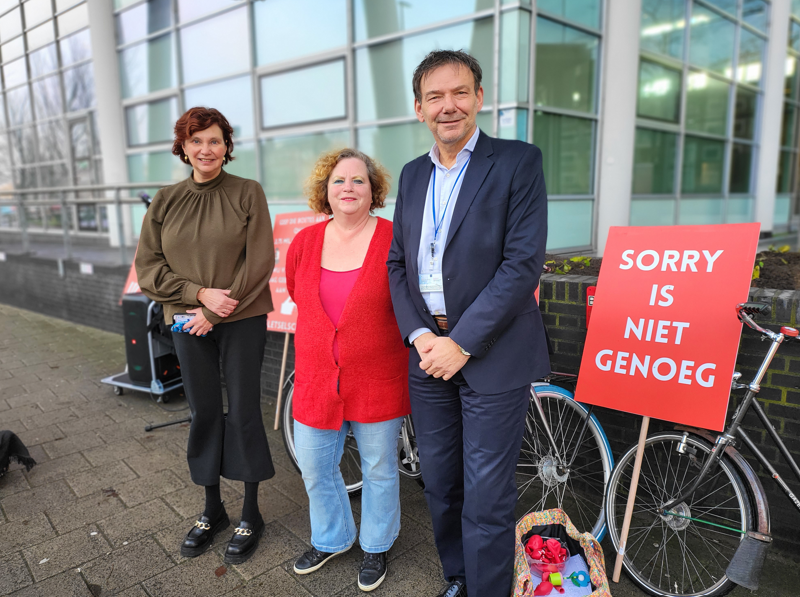
In December 2022, we organized a demonstration with a group of parents on the sidewalk at four tax offices in the Netherlands. I stood at the office on the Graadt Roggenweg. Employees are afraid of us. The management of the Benefits Recovery Agency (UHT) apologizes that only they are willing to speak to us. Anyone who wants to can work from home.
In December 2022, a ventriloquist civil servant appeared on Nieuwsuur for the first time with a distorted voice, a silhouette, and a wig: the famous 'wig broadcast'. Parents are being labeled as affected too quickly. Files cannot be assessed properly. Capacity is being wasted.
In 2023, the Gelijkwaardig Herstel Foundation comes up with a solution. VSO (settlement) processes are also being started internally at the same time. The Strategy, Policy, and Law department is all over it. Only 20% of the damages are allowed to be paid out.
Princess Laurentien (L10) also has to deal with the gang of anonymous civil servants. They file complaints about her style and influence. In the autumn of 2024, the organization is put on hold. After the restart, the Ministry of Finance takes over the working method itself.
20,000 parents wrongly compensated due to 'non-response' because they were asked to prove their right to childcare benefits? Half of the parents. Who believes this nonsense?
I also recently found the letter in my files. I had already submitted the annual statements long ago, three times in fact. Through my accountant, through an employee, and through the childcare institution.
How the recovery of the childcare benefits scandal went off the rails: at least 20,000 parents received compensation incorrectly
background
Childcare benefits Civil servants warned early on that the Ministry of Finance was being far too generous in giving parents 30,000 euros or more in damages during the settlement of the childcare benefits scandal. This came "at the expense of being able to help the actual victims in a timely manner."
- Derk Stokmans Stefan Vermeulen from The Hague


- Derk Stokmans
- Stefan Vermeulen from The Hague
- Published onJune 15, 20268-minute read
ListenGive giftShareReading list
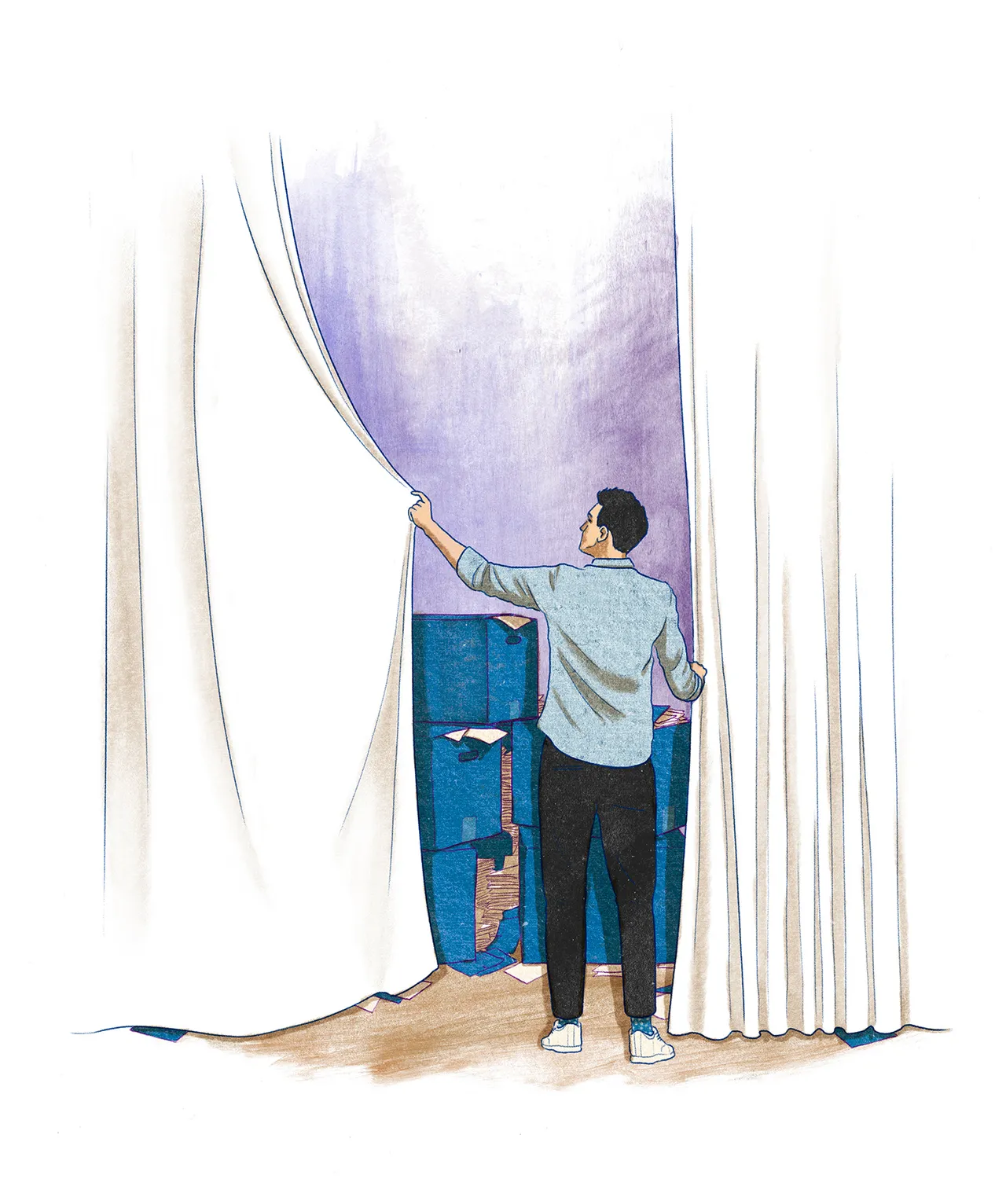
The Ministry of Finance has incorrectly designated at least twenty thousand parents as victims of the childcare benefits scandal. Without good reason, they received 30,000 euros or more in compensation from the government. This is according to seven sources who were closely involved in the assessment of these parents.
In recent years, senior officials and responsible politicians repeatedly ignored internal warnings that the government was incorrectly recognizing a large group of parents as victims. This allegedly delayed help for the real victims of unjust government actions. This is evident from internal emails and memos that NRC reviewed and conversations with the sources.
In a response, the ministry does not explicitly refute NRC's findings but states that "without re-evaluating all individual files [...] no well-founded conclusion" can be drawn about how many parents were incorrectly labeled as victims.
NRC brings you the best of The Economist
Sharp international analyses, selected by the NRC editorial team
View the selection

In 2018, it was revealed that the Tax and Customs Administration had wrongly labeled recipients of childcare benefits as fraudsters for years. These individuals subsequently faced harsh and relentless recovery demands. This plunged families into severe financial distress, leading to divorces or children being removed from their homes. In 2020, the cabinet decided to compensate the victims. Initially, the cabinet expected a few thousand victims, but ultimately, 44,000 people were recognized as such.
More than twenty thousand of these parents were classified as victims because the Tax and Customs Administration allegedly stopped their benefits without warning via a "stop letter." Because the government had not given parents a chance to prove their entitlement to benefits, this was considered "bias," entitling them to compensation. According to an internal memo, this was "the most common reason for granting compensation."
From the very beginning of the recovery operation, employees of the Benefits Recovery Agency (UHT) warned that there was no bias involved for this group at all. Consequently, these people were not victims of the benefits scandal. UHT is the crisis organization within the Ministry of Finance that determines compensation for parents affected by the benefits issue.
Internal letter records showed that the Tax and Customs Administration never simply sent a "stop letter." Parents whose information was missing to determine their benefit entitlement were first sent two letters requesting that they submit the information. For example, they had to provide an annual statement from a recognized childcare provider, showing how many hours their children had attended and what the associated costs were.
Only then would the stop letter follow, announcing that benefits would be terminated if the information was not provided. Even then, the benefits were not permanently stopped: if parents filed an objection and provided the requested information, they retained their entitlement. Many parents did exactly that.
Earlier this year concluded the Audit Service of the Central Government (ADR, the government's internal auditor) after an investigation that there was no doubt about the accuracy of these letter records. A sample showed that all parents who received a stop letter had also received the previous letters.
According to employees, internal critics were ignored, denied contract renewals, or left the organization out of frustration.
State secretaries responsible for the recovery operation in recent years knew the letter records existed but blocked their use by the UHT. Without examining the records, it was assumed they were incomplete, irrelevant, or that using them did not fit "the background of the recovery operation"—namely, that the government had treated parents poorly and that parents who identified as victims were indeed victims.
According to critical employees, the responsible senior officials and politicians did not want to admit that a large part of the recovery operation was built on shaky ground and that compensation was being paid to many parents who were not entitled to it. These employees also stated that those responsible feared being accused of being too harsh on affected parents again—and thus having learned nothing from the benefits scandal. According to employees, internal critics were ignored, denied contract renewals, or left the organization out of frustration.
In its response, the ministry writes that at the start of the recovery operation, a "widely shared assumption emerged" that the letter records were incomplete. Therefore, it was decided to make the parents' accounts the guiding principle, an "approach shaped partly at the instigation of Parliament." Parents who claimed they never received a letter before the stop letter were therefore believed. Although there were "signals" over the years that this assumption was incorrect, these were not seen as "concrete indications" that a letter record might actually exist.
A "light touch" for victims
How did it come to this? In early December 2020, a UHT employee heard that the Tax and Customs Administration's Central Administrative Processes (CAP) department in Apeldoorn held extensive information about letters requesting information that benefit recipients had received. The employee found this interesting—within the UHT, it was assumed that sending those letters could not be proven. Parents who claimed their benefits were stopped without warning were therefore immediately entitled to compensation.
But what if parents had actually been given the chance to provide that information, and even multiple times?
The employee emailed a "technical coordinator." These colleagues are responsible within the UHT for the legally correct execution of the recovery operation. Should we not use the letter records when judging whether someone is a victim, the employee asked. "This issue occurs with many parents."
In the email, the employee described how meticulously every step of the letter process is recorded. This makes sense: one of the core tasks of the Tax and Customs Administration is sending out massive quantities of standard letters; every taxpayer receives a few each year. To prevent the agency from getting bogged down in endless discussions during legal proceedings about whether or not a tax letter arrived, this is documented precisely.
But the technical coordinator replied that "it was decided" not to use these letter records in the recovery operation. Because then the UHT would also have to prove that the parent did not provide the requested information. That is impossible, the coordinator wrote: there are known cases where a parent proved that information had been sent, even though it was not in the computer systems.
Involved employees find this a strange line of reasoning: how can parents who claim they did not receive a letter before their benefits were stopped simultaneously declare that they had sent the information that the letter requested?
I'm listening to 'The Childcare Benefits Scandal: how the term ‘victim’ was unfairly stretched' (NRC Vandaag) in the NRC Audio app:

NRC VandaagJun 15, 2026 20 min
The Childcare Benefits Scandal: how the term ‘victim’ was unfairly stretched
Progress:
The recovery operation would soon derail. A day after the email exchange, the Rutte III cabinet, under pressure from the House of Representatives, announced the so-called Catshuis scheme: anyone who appears to be a victim after a ‘light assessment’ will receive 30,000 euros regardless, even if the actual financial damage was less or if someone turns out not to be a victim after a more thorough review.
At that point, nearly 10,000 parents had signed up. Within a few months, another 30,000 people joined, far more than the few thousand victims the cabinet had counted on. Eventually, nearly 70,000 people would come forward, of whom the UHT recognized approximately 44,000 as victims. It soon became clear that the UHT could not process these numbers quickly enough. The employees – who mostly joined the organization because they wanted to help – were drowning in file preparation and objection procedures.
A large portion of these parents were recognized as victims solely because they had received a termination notice, according to information on individual cases reviewed by NRC. In a substantial number of cases, there had not even been a recovery claim, because they provided the requested information after receiving the notice and thus secured their benefit.
Some parents even received more benefits based on the information provided. The ‘damage’ suffered consisted of nothing more than correspondence with the Tax and Customs Administration, often years ago. Yet they all received at least 30,000 euros, their debts were written off, they received support from their municipality, and each of their children became eligible for up to 10,000 euros in compensation.
On average, recognized victims received 110,000 euros, according to the ministry. If the correspondence records had been used from the start of the recovery operation, it would have saved hundreds of millions of euros in wrongly paid compensation.

Help for real victims stalls
The fact that the government is paying compensation to these parents is causing growing internal resistance. In March 2022, the twelve ‘technical advisors’ who oversee policy implementation within the recovery organization UHT met in a room in Amersfoort. The twelve saw how the operation was spiraling out of control. The UHT was recognizing so many people as victims that the help for the most severely affected families was in danger of stalling.
People who claim their childcare benefit was stopped and reclaimed without any warning are being recognized as victims in “almost all cases.” According to the technical advisors, this is not justified. They “cannot reconcile themselves” with this approach, they wrote to their managers.
After all, this is not about the people with whom the benefits scandal began: parents who were treated harshly and unfairly by the Tax and Customs Administration because of unproven suspicions of fraud. These parents simply received the usual standard letters, which have been sent millions of times since the benefits system was introduced in 2006. Every citizen who receives a benefit must, after all, demonstrate that they meet the requirements.
Recipients of childcare benefits who did not respond to multiple requests for information are therefore not victims of a biased approach by the Tax and Customs Administration, the employees believe. Because if you cannot stop a benefit after three unanswered requests for proof, when can you?
Of course, the employees do see the suffering of parents. This is often due to personal circumstances – debt, divorce, illness, or job loss. They also see people who do not fully understand how the system works and who get lost in the administrative requirements. But none of that is the fault or responsibility of the Tax and Customs Administration, and certainly not the result of poor treatment by the government.
The staff raised the issue with their managers multiple times in the spring of 2022, but to no avail. In September, they documented their concerns in a series of memos. The technical advisors wrote that they were seeing their colleagues "encountering more and more cases where there was no question of victimization," yet they were still required to pay compensation to parents who, "in our view, are wrongly classified as victims."
In this way, so many people are being recognized as victims that the processing time for files keeps increasing. According to the advisors, this comes "at the expense of being able to help the truly affected parents in a timely manner."
In November 2024, a five-page internal memo regarding the Tax Authority's correspondence records landed on the desk of State Secretary Nora Achahbar (Benefits, NSC). Achahbar had only been in office for a few months at that point. Finally, four years after the initial warnings, an internal investigation into the correspondence records was launched that summer. This happened after staff had once again pointed out the large numbers of parents who were being wrongly recognized as victims.
The correspondence records are professional, well-documented, and complete, concluded the officials who investigated the matter. They dismissed the "widespread belief" that there were no proper records. The fact that this narrative was being circulated internally can only mean, according to the authors of the memo, that the matter was not properly investigated earlier. It now appears that the fact that parents had indeed received those earlier letters has "a major impact" on the assessment of whether or not they are victims.
This did not lead to any great sense of urgency among the ministry's top leadership. In February 2025, UHT director Anne Coenen shared the memo's conclusions with colleagues. "We all would have much preferred to have known about these files right from the start," she said during a video meeting. "We also wonder: how is it actually possible that we only found out about this so late?" She described the fact that thousands of people may have been wrongly recognized as victims during the recovery operation as "quite complicated."
State Secretary backtracks
But only after NRC published a report on the matter in March 2025did State Secretary Sandra Palmen (NSC) – Achahbar’s successor – announce an external investigation by the Government Audit Service (ADR).
Even then, doubt was being cast on the correspondence records at a high official level. A close advisor to Palmen emailed senior officials involved, stating that the letter to Parliament regarding the issue should not refer to an "administration" because the dispatch dates were allegedly unreliable. Palmen herself, a staff member emailed colleagues, said in an internal meeting that the correspondence records "could never be decisive" because they are only "a kind of mail log," and it is unclear whether people actually responded to those letters.
Despite the expectation that the investigation could be completed quickly, it took nine months – until December 2025 – before the ADR had a first draft report ready. And then another four months before Palmen sent the investigation to the House of Representatives.
The ADR report left no room for ambiguity: the Tax Authority's systems contained "accurate and complete dispatch and receipt records." In a response, State Secretary Sandra Palmen had to admit that the records would have been relevant in assessing victimhood. According to the ministry, not using the database had "potential consequences for the lawfulness" of the compensation paid out. "If this information had been known and used in a timely manner, it could potentially have influenced conversations with parents about their victimization," the ministry wrote in its response.
For the recovery operation, the conclusions came too late: the UHT had already assessed almost all potential victims. The cabinet does not intend to reclaim money from parents who were not actually affected, nor to determine how much money was paid out unlawfully. These parents can also continue to claim additional compensation schemes. "We do not want to cause uncertainty for parents, but rather restore trust."
.avif)