The compensation scheme for the benefits affair: inexplicable, unenforceable, unaffordable


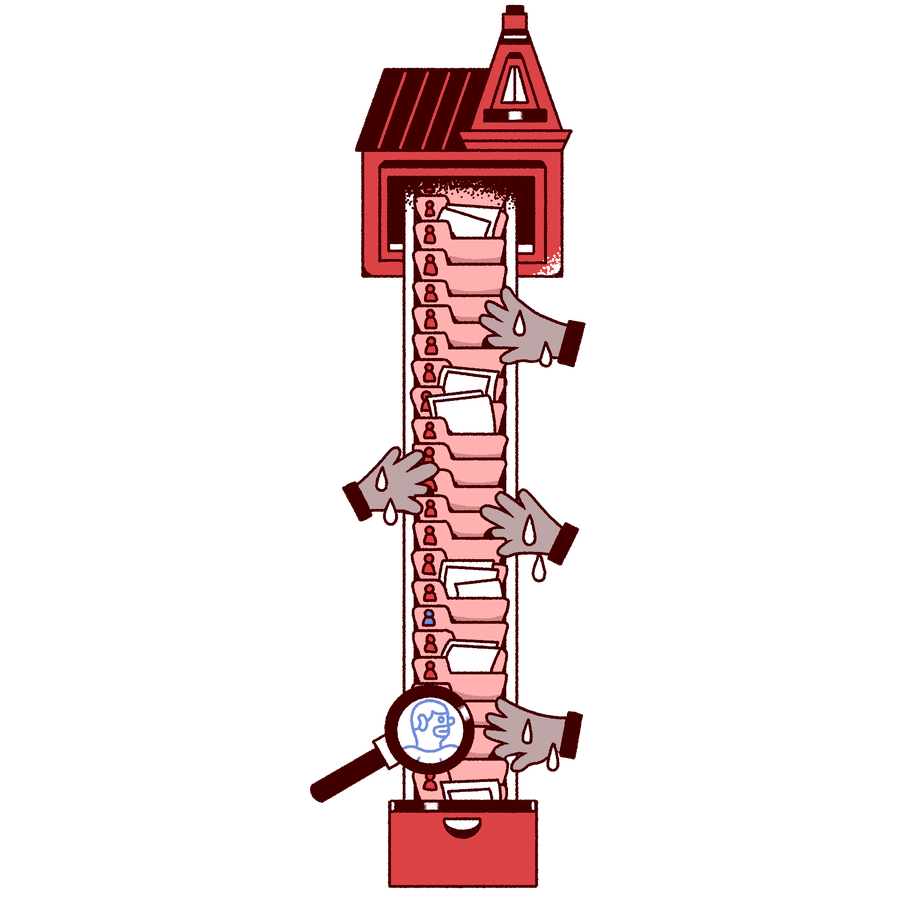
Earlier, we already published illustrator Mart Veldhuis's 'Eigen Schuld' tapestry, about the life of a student with a high student debt. Now he made a sequel on behalf of De Correspondent, but about the benefits affair.
The recovery operation for those affected by the benefits affair is getting further and further out of hand. About four years ago, it was expected that the government would have to set aside several hundred million euros to compensate around 2,000 victims. 68,921 people have now reported as victims, 35,537 of whom have been recognized as victims. No less than 9.3 billion euros have been set aside for the compensation scheme. The question is whether it will end at nine billion. In a recent letter to Parliament, Secretary of State Aukje de Vries (Surcharges and Customs, VVD) warns that a further extension of the compensation scheme could result in an additional 1.2 to 4.7 billion euros. This would — in the extreme case — amount to around 14 billion euros.14 billion euros. It's about what we spend on primary education every year, it's about three years of youth care budget, it's fourteen years of subsidies for public broadcasting. It's also three times more than childcare allowance was recovered from all Dutch people (4.3 billion euros) from 2005 to 2020. And almost seven times more than the 90,000 Dutch people who had to repay more than 10,000 euros in childcare allowance were collected (2.1 billion euros). In short, it is quite a lot of money.
Around a fifth of that amount goes to the Implementation Organization for Recovery of Surcharges (UHT) itself, where around 2,277 FTEs are now employed. By comparison, when the misery occurred between 2010 and 2014, around 600 people worked at the Tax Authority/Allowances. By the way, 21 percent of implementation costs in the genre of compensation schemes are not even very excessive: when dealing with Groningen earthquake damage, almost 41 percent of the budget went to implementation costs last year. Although that difference is mainly because the compensation scheme for the benefits affair pays much larger amounts than in the event of earthquake damage.
The term “victim” expands
Well, how is it possible that the compensation scheme bill has risen so high? First of all, it has to do with the expanding concept of “duped”. Secretly, there has been a substantial discrepancy between the victim in the public imagination and the victim in the compensation scheme. In the public debate, victims are people who have been brusquely run over by the government for petty offences. They are people who lost their jobs, their children, their marriages. But the compensation scheme now concerns just about everyone who has ever gone wrong with childcare allowance. This may involve recoveries of a few thousand euros or recoveries of more than a ton. It can be a missing signature on a childcare contract or a lack of payment of a few hundred euros (indeed: petty offences), but it can also be about people who never responded to letters from the tax authorities, or even deliberately cheated on things.
Just about everyone who has ever gone wrong with childcare allowance has been 'duped'
Technical advisors at the UHT write in an internal note dated September 2022 that they have concerns about this “increasingly expanding the concept of victim”. The assessment criteria “frequently lead to overcompensation”. “The overall picture of the assessment teams is that, after the first thousands of reviews from parents, we find more and more cases where there is no case or should be duped,” write the advisers. An example: if parents did not respond to requests for information during an audit by the tax authorities, the childcare allowance was stopped and recovered at some point. In the compensation scheme, such a recovery due to a lack of response is now considered an “institutionally biased course of action”. In other words, you get a bag of money because you never responded to repeated requests for information. According to the note, this compensation ground is present in “a very large part of the files”. “The term bias has taken on a different meaning [within the compensation scheme] than in common parlance,” note the authors of the note. “If two written requests for information are insufficient, how far must the Tax Administration/Surcharges go before the right to childcare allowance can be stopped?” By the way, those who do not respond to letters from the Tax Authority/Surcharges today will still simply receive a refund. Which, of course, is strange: if you do it now, you can pay everything back; if you did it then, you will get 30,000 euros. The authors of the note fear that this may be contrary to the principle of equality. They therefore recommend that, when it comes to compensation grounds, at least check whether a “working method is still carried out in the same way today”. Parents can even receive compensation without ever recovering. When parents took action after a threatening tax letter and still provided the necessary information, they were able to prevent recovery. But even in those cases, someone is considered a victim. Indeed, the letter announcing a recovery would have caused pain to the parent (in UHT jargon, it's called “a shock letter”). Another example: anyone with “intention/gross negligence” (O/GS) is considered a victim of the benefits affair. What is O/GS? Once it was determined that a parent had no or less right to receive childcare allowance, the question arose whether someone could get a personal payment arrangement. If, according to the tax authorities, the recovery was due to “serious negligence or gross negligence”, it refused to offer such a payment arrangement. In those cases, a parent had to repay the childcare allowance in 24 months, which often led to coercive recovery, because it is impossible for most people to cough up tens of thousands of euros in 24 months. Rulings by the Council of State show many examples of why O/GS was established: someone who applied for childcare allowance for other people's children; someone who increased the number of childcare hours twelve times in two years, while her daughter did not receive childcare at all; or someone who never responded to requests to send bank statements to the tax authorities. In all these cases, the Council of State found that there was “serious negligence or gross negligence”. For the UHT, however, all these people are victims of the benefits affair.

The other extreme: those who deliberately abused are now also victims
Now you may wonder if it is fair to push someone who cheated on things into the financial abyss. Is O/GS' retaliation commensurate with the offence? Politicians now think so: almost everyone gets a customized payment arrangement. But it is another extreme to now consider people who deliberately abused childcare allowance en masse as victims. It is not without reason that, following reports from De Correspondent, the Secretary of State had to acknowledge that fourteen people involved in the criminal investigations in 'Alabama' and 'Florida' (popularly known as 'the Bulgarian fraud') had received compensation. Why? “It is not being considered [...] whether the O/GS qualification was also justified with today's knowledge,” wrote the Secretary of State. Since the benefits affair, the reflex to dismiss any signal of abuse has been empty ballot. The Bulgarian fraud caused a political stroke, but upon closer inspection, this fraud was pointless in the mass of surcharges. So now it appears that some co-perpetrators of the Bulgarian fraud are receiving compensation because they were duped by the benefits affair (Oh, irony!), we shouldn't go overreacting again — most people are good! There is, of course, something to be said for that. Remember: over the years, only 335 million euros in O/GS has been set out of a total of 38.5 billion euros in childcare benefits (a mere 0.8 percent). However, O/GS's compensation is not about “all applicants for childcare allowance”, but about “the 0.8 percent of whom the tax authorities thought were abusing”. It is quite reasonable to believe that abuse is not so bad in that first group; it is completely incongruous that there would never have been anything wrong in that second group. It actually assumes that the tax authorities over the past twenty years never someone has rightly accused of abuse. For example, the history of the benefits affair seems to be slowly repeating itself in a mirror image. Where the smallest mistakes were previously sought to recover large amounts of surcharges, the least reason is now being sought to pay out large amounts of compensation.
Politicians want to buy speed with a grand gesture — but it only takes longer
The second reason for the expanding bill of the recovery operation is that more and more regulations have been created over the years. Arrangements that invariably assume that the worst victims are decisive for the entire group of more than 35,000 victims. After the parliamentary questioning about the benefits affair, the cabinet decided in January 2021 to give all victims 30,000 euros after a “light test” (the so-called Catshuis scheme). Around 8,000 people had registered as victims at that time, but that would quickly rise to almost 70,000 in the years that followed. This is a constant in the compensation scheme: frustration with the slow progress of the compensation scheme leads to the political desire to buy speed with a grand gesture. But the generosity quickly means that registrations are much higher than expected. What was intended to be an acceleration thus turns into a deceleration.
Once people pass the “light test”, they not only claim 30,000 euros, public debts are also forgiven (an average of 21,000 euros); private debts (an average of around 9,000 euros); the children of victims receive 2,000 to 10,000 euros each, depending on their age; and the former partner also receives 10,000 euros. Victims receive this compensation regardless of what is actually reimbursed in childcare allowance. It is not necessary to prove that there is a causal link between the resulting debts and the benefits affair, that children suffered from the recovery, or the former partner had something to do with the allowance claim. Moreover, for the vast majority of victims, the compensation amounts paid are a multiple of what has ever been recovered. Even among the target group with the heaviest recoveries — the 16,806 parents with O/GS — the median recovery was 14,075 euros (i.e., half had a larger recovery, the other half had a smaller recovery). The recovery operation of the benefits affair is therefore generous compared to compensation schemes for other government failures. Dutchbat III veterans received a one-off compensation of 5,000 euros. Relatives of the victims of the Srebrenica genocide: 15,000 euros for widows, 10,000 euros for other family members. Young people who experienced violence in youth care received 5,000 euros. Young people who were victims of “sexual intrusion abuse” in youth care: 10,000 euro. Limburg miners who died years earlier due to severe lung disease received 9,075 euros (and if you had a bit of dust lung, you could forget it). And these are the cases of government failure where compensation is awarded at all. Compensation is often not even an issue. Consider, for example, the tens of thousands of people who were thrown into prison because of traffic fines they were unable to pay. Now suffering is difficult to compare, but it is remarkable that an adult child born to someone who once had to pay back a few thousand euros in childcare allowance receives twice more compensation than a child who experienced violence in youth care and as much as someone who was raped in a foster family. Or that someone who once received 'a shock letter' from the tax authorities receives at least three times as much compensation as a child of a murdered father who unsuccessfully sought protection from Dutch soldiers in Srebrenica.
The real victims have been lost.
And these arrangements are just the beginning. After the “light test”, reporters can still request an “integral assessment”, looking in more detail at what happened. Victims hereby receive the amount of the “wrongful” recovery or termination plus 25 percent, plus 500 euros of intangible compensation for each six months since recovery, plus statutory interest on the amount recovered, plus reimbursement of legal fees incurred, plus reimbursement of recovery costs paid. If the amount resulting from the comprehensive assessment exceeds the 30,000 euros already transferred, victims will receive additional compensation. This can already be the case with recoveries considerably smaller than 30,000 euros. For example, someone with a 2012 recovery of 12,500 euros in childcare allowance will already be entitled to more than 30,000 euros in the comprehensive assessment. A recurring theme in the coverage of the compensation scheme is that victims are still waiting for their compensation. This is mainly about the syrupy progress of these integral assessments. In addition, it is important to note that victims already have up to 30,000 euros and discharge of their debts. ontvangen.Dat integral assessments are a long time coming, in turn, has everything to do with the political choice of the cabinet and the House to pay 30,000 euros. The Court of Auditors writes in its 2023 accountability study that “the large number of applications [after the Catshuis scheme] is the main cause of the long lead time”. The Catshuis scheme has left the real victims lost in a growing mountain of moderate to non-victims. “The unclear definition of generous recovery and the lack of barriers [...] have a downside,” notes the Court of Auditors. “Partly as a result, the most affected parents have to wait longer to process their file.” Even people who have no chance of getting compensation have an interest in reporting to the UHT. After all, as a potential victim of the benefits affair, you have many more rights than as a victim of regular misery. For example, anyone who reports as a victim will immediately pause the collection of government debts, and they will remain paused as long as there is no definitive rejection. And that final rejection can be a long time coming. Applicants receive free legal assistance from the government, so legal remedies are quickly brought against the UHT. After a negative decision by the UHT, applicants therefore file frequent objections and appeals (even if that is unlikely). There are already more than ten thousand objections to UHT decisions. To get rid of this workload, the ministry is now considering “unorthodox measures” to buy off appeal proceedings with, for example, a settlement proposal of 5,000 euros.
In addition, it has proven impossible for the UHT to complete the comprehensive assessments within the statutory decision periods (two times six months). The result is that 34,462 notices of default have now been sent and 11,237 appeals have been lodged for late decisions. For this purpose, 56 million euros in penalty payments have already been paid by the UHT. (Penalty payments that are therefore also collected by people who will never be considered victims.) The UHT has tried unsuccessfully to oppose these penalty payments before the Supreme Administrative Court. The UHT had received an impossible task, the Council of State ruled, but impossible tasks must also be carried out. “The legislator has deliberately accepted a regulation with factually unattainable decision periods,” according to the ruling. “Aware, because various progress reports [...] showed that the decision deadlines were not met and this was also discussed during the parliamentary discussion of the Recovery Operation Surcharges Act.” A bill is now being prepared to change the decision deadlines anyway.

A parallel welfare state
And then there are the municipalities. Potential victims of the benefits affair are entitled to “broad municipal support”. Where this municipal support should begin and end is unclear: “do what is necessary” and the receipt can go to Finance is roughly the order. However, the sharing of information between municipalities and the UHT is sad, so that municipalities do not know the difference between “applicants” and “recognized victims”. Remember: there are almost seventy thousand applicants and only half of them have been duped. “Currently, municipalities are barely getting this information [about recognized victims],” an official note to the Secretary of State states. 'The reason for this is that it has never been determined at what point in the recovery process someone is permanently “unaffected”. ' As long as an integral assessment, objection or appeal is ongoing, people can seek support from the municipality.Peter Heijkoop, alderman in Dordrecht and head of the Association of Dutch Municipalities (VNG), recently sounded the alarm about the parallel welfare state that is slowly emerging. He noted a growth in mainly material requests for help. “Some send 16-page lists of items, including the desired brand and sometimes the store where to buy them,” Heijkoop said. “Look, if a parent has never been able to buy a new mattress and suffers from back problems, the team will provide a new mattress. Right away. But we also receive requests for electric bikes, multiple laptops for the family, airline tickets. What do we do with that? Each municipality deals with it differently. “The annual report for 2023 by the municipality of Amsterdam shows that in the capital, 1,364 households with an average amount of 8,599 euros per household are now making use of municipal support. The annual report notes that the budget was intended to “provide first urgent and necessary material assistance”, but that it now concerns requests for “a diverse range of goods and services” that “partly also have the character of compensation for damage suffered”. Spending increased rapidly in the capital: from around 150,000 euros per month in early 2022 to over 1.3 million euros in December 2023. This growth is also reflected in the State's data. Around 10 million euros were initially budgeted for municipal support in 2023, but this amount would eventually amount to 105 million euro.Dat the material requests for help increase is remarkable, as you would expect the profession to decline as more victims are helped with 30,000 euros and debt discharge. By the way, the municipalities do not link back to the UHT what they offer in terms of help: the material support from municipalities comes on top previously paid compensation.
An excruciatingly slow processing
Finally, once the comprehensive assessment has been completed, parents can submit a request to the Actual Damage Commission (CWS). This scheme was intended for the most severely affected parents to recover consequential damage from the benefits affair from the government: relationships that were on the rocks, forced removals, lost incomes. Unlike the other regulations, the CWS does expect evidence of a causal relationship between the recovery of benefits and the damage suffered. In addition, the intention was that the CWS would deal “generously” with the burden of proof (as in: as generously as possible within civil claims law). But the processing of claims for damages with the CWS is also excruciatingly slow. Of the 3,815 requests, only 497 were dealt with, with parents also objecting to half of these decisions. The heavier burden of proof also makes parents feel mistrust. The House of Representatives has therefore called for a more generous way of buying speed.
Recently, an alternative process has been piloted at Princess Laurentien's Foundation (Equal) worthy Recovery (SGH). In this process, volunteers (so-called “listening writers”) record the parent's story, after which damage assessors attach an amount to the events described. The evaluation of this trial shows that the amounts paid out with this foundation (average: 128,000 euros) are significantly higher than with the CWS (average: 18,000 euros). Finance officials warned in advance that it is “very likely” that the General Court of Auditors will consider payments via the SGH as “uncertain or unlawful”. Indeed, the Repair Operation Surcharges Act states that a victim makes her actual damage “plausible [...] in accordance with civil compensation law”. But this would probably no longer be the case with the SGH route. The evaluation of the SGH trial shows that this fear is justified. At least 30 percent of the files awarded damage prior to the first recovery of childcare allowance. This is an example of a victim who was awarded seven years of full-time income damage because she quit her education in 2007 (while the first recovery of childcare allowance dates back to 2009). The other 70 percent could not say with certainty that no damage from before the benefits affair had been awarded, because the documentation was insufficient to substantiate damage. In response to the evaluation, SGH states that it is based on the parent's story. If parents say that surcharges were recovered earlier than the tax authorities' systems show, the parent's story is believed. The same applies to parents who say they have stopped working, although UWV data shows that they have continued to work. Sequence — that an event occurred after a childcare allowance was recovered — is a prerequisite for causality. But it is not said that every event after a recovery is automatically the result of the benefits affair. SGH now awards compensation for “unable to work or less” in three quarters of the files for an average amount of 91,677 euros. At the CWS, this post is awarded in only 16 percent and is an average of 22,000 euros. But whether, for example, an unfulfilled ambition to study is entirely due to a recovery of childcare allowance, is quite debatable. Also remember that many victims could have problems even before the benefits affair. Of those affected with intention/gross negligence, according to data from the Central Bureau of Statistics (CBS), 46 percent were already out of work in the year before the first recovery (6 percent among ordinary applicants for childcare allowance), a quarter were living with a suspect of a crime (5 percent among ordinary allowance applicants) and 30 percent had been in arrears on health insurance for more than six months (2 percent under ordinary allowance applicants) applicants). Finally, the SGH often appears to award damages that are multiple than the original recovery. For example, someone with a recovery of just over 1,100 euros was awarded compensation of more than 83,000 euros by SGH. This is not exceptional, according to the evaluation: amounts of up to more than two tons are regularly paid out when recoveries of less than ten thousand euros are paid out. SGH explains this by the “domino effect”: the recovery of childcare allowance has caused a cascade of misery.
But there may also be something else going on. The recognition that someone is a victim (even if it involved a recovery of a thousand euros) can result in parents retroactively attributing all the misery that happened to them to the benefits affair. The Netherlands does not have much patience for regular suffering, but those who present themselves as victims of the benefits affair will hear from the authorities, the immediate environment, and even the Royal House. Parents are thus increasingly linking their life story to the benefits affair. The problem is that this version of history does not always find full confirmation in the facts. You could say that rejecting real damage is no longer just about the case itself, but affects how someone has come to see themselves. The impossible choice in politics: stick to objective observation (which will disappoint people) or abide by subjective experience (which will ruin the truth).
Inundated with claims
It is clear, however, that the SGH route is greatly appreciated by victims. Volunteers really listen to parents' stories; something for which at the UHT, which is strongly focused on handling files, there is really no room for. “All [parents] we spoke to are satisfied with the route,” the evaluation therefore states. “The trust in the Fact Report with limited request for supporting documents is considered pleasant by parents.” The process at the SGH also ends in a settlement agreement, so it really is can be closed. Because the parent's story is based on the parent's story, volunteers do a lot of work, and avoid costly legal trench warfare, the implementation costs at SGH are currently ten times lower (an average of 3,555 euros per file) than at the CWS (36,000 euros). At the CWS, the implementation costs are extensive. twice (!) higher than the compensation paid out. In addition, it takes approximately 60 weeks to process actual claims with the CWS, while it takes 21 weeks at SGH. However, the question is whether, like the Catshuis scheme, the SGH will not be overwhelmed by claims, so it will not be able to fulfill its promise either. The popularity of the CWS is currently losing rapidly compared to SGH. Applications to the SGH rose from a few hundred in November 2023 to a few thousand in April 2024. The Equal Recovery Foundation itself assumes that 25,000 parents will eventually report to her (six times more parents than have reported to the CWS to date). Is a foundation that runs on volunteer work able to handle tens of thousands of diverse requests? So far, 2,200 volunteers have reported to SGH, two thirds of whom have completed a listening writer course, and 5 percent say they want to write a second story afterwards. To help 25,000 parents, the evaluation estimates, around 40,000 volunteers are therefore needed. SGH itself says that recruiting so many volunteers won't be a problem. The evaluation of SGH, on the other hand, does find “risks for scaling up”. Secretary of State Aukje de Vries decided not to sign new settlement agreements via the SGH route for the time being after the end of the trial. “There were a number of things that came out of the evaluation that I'm not very good at explaining to the rest of the world,” says De Vries. The ministry first wants to reach new agreements with SGH about the “explainability of the results” and “guarantees to make scaling up possible”.
“There were a number of things that came out of the evaluation that I'm not very good at explaining to the rest of the world,” says De Vries about the SGH.
Nevertheless, De Vries indicated that he wanted to continue with the Equal Recovery Foundation. The cabinet “wishes to formalize and scale up this damage route,” she writes in a letter to Parliament. With the new agreements, the average compensation was expected to be 85,000 euros instead of 128,000 euros (still five times higher than CWS). In her letter to Parliament, De Vries already alludes to a change in the law to legalize SGH's way of working. Indeed, it is currently difficult to maintain that SGH still acts “in accordance with civil compensation law”, as the Recovery Operation Surcharges Act prescribes. No one knows exactly how many victims will report to SGH and what amounts they will claim. In her letter to Parliament, the Secretary of State writes that the costs of this damage route — provided the ministry can reach agreements with SGH about 'explainability' — will be somewhere between 1.2 billion and 4.7 billion euros. The temporary shutdown of the SGH led to a fierce response from Princess Laurentien. Watch Princess Laurentien's video message here.“Again, that helplessness, loss of direction, others deciding about you, ambiguity, uncertainty, and scars that are being opened up again,” the princess said in a thirteen-minute video message. She opposed the accusation that her foundation's compensation was not explainable. “Everything we do is explained,” she said. “Perhaps we are no longer used to setting up a process based on the person concerned, from trust, and not deviating from it. “It is now up to the House of Representatives to decide whether and under what conditions it wants to continue the damage route via SGH.
What has the political involvement yielded?
There is no topic that has been debated more frequently in recent years than this recovery operation. Every quarter, the House of Representatives enforced another list of commitments and filed a list of motions. But what has all that intensive political involvement resulted in? We now have an inexplicable compensation scheme that will cost more than 10 billion euros. And despite all that money and effort, it seems to be many years before the recovery operation can be completed. “Unrealistic expectations and promises ultimately lead to disillusionment and distrust, even if they are expressed with the best intentions,” the Council of State said last month in an opinion on the umpteenth amendment to the Recovery Surgery Allowances Act. In an emotionally charged atmosphere, it has proven impossible to discuss the essential questions about the recovery operation. What exactly is a victim? What are we compensating for? Is that still in any relation to the damage suffered? Can this still be explained to victims of other government failures? Aren't the interests of severely affected people subside by compensating everyone so generously? And don't we consistently create disappointments by making promises that we know can't be kept? As early as March 2020, the Donner Commission warned that if it were not clearly defined who is entitled to compensation, the recovery operation would end irrevocably. “An approach to the legacy of fifteen years of childcare allowance [...] will be an exceptionally large project,” warned the Donner Commission. “The risk is therefore real that the civil service [...] will be flooded by a wave of requests within a short period of time and will drown in them. That should not be underestimated. “But it is underestimated. And it continues to be underestimated. Every debate, MPs mainly deal with gratuitous calls to compensate faster, more generously and more humanely. For example, at the last debate, Jimmy Dijk (SP) suggested shutting down the UHT, in favor of a “one-day treatment” in “gymnasiums and community centers”. A classic that the SP has been contributing to these debates for a few years. It has just as often been explained that this is completely impossible, because it is not as simple as it seems in the public imagination. A one-day treatment trial also showed that, but that doesn't seem to bother Dijk. Luc Stultiens (Groenlinks-PvdA) suggested that we “start from trust instead of distrust”. A refreshing suggestion, apparently paying out tens of thousands of euros on the basis of an increasingly looser concept of victim suspicion. And Nicolien van Vroonhoven (NSC) called for a wave of dismissal at the UHT. “My group is convinced that recovery will only really fly if there is a change in the staffing, the people who should carry out the recovery,” she said. Wonderful, yes: a bit like politics first promised that the National Railways will drop off the train passenger at the door from now on, and when it turns out that the NS is unable to do so, concludes that the NS can't do anything about it. “Time for a different staff!” After the benefits affair, it rained pious intentions to listen better to the implementation and to put the quality of legislation first. Little of that has ended up in recovery surgery. The main lesson they seem to have learned is to pull the wheel very hard in the other direction. And so we are now driving the other way — from a benefits affair to a compensation affair: the same mistakes, now mirrored. Peter Heijkoop of the Association of Dutch Municipalities rightly noted that it cannot be ruled out that we will receive another parliamentary survey about this.
You read this story for free, but making this story takes time and money. Support us and make more stories possible beyond the issues of the day.Right from the start, we become funded by our members and we are complete ad-free and independent. We create profound, connecting and optimistic stories that provide insight into how the world works. So that you not only understand what is happening, but also why it is happening. Especially now, in times of increasing uncertainty and mistrust, there is a great need for stories that go beyond the issues of the day. Stories that deepening and connecting bring. Stories focused not on the sensational, but on the fundamental. Thanks to our members, we can keep making stories for as many people as possible. Become a member too!
Become a memberAlready a member? Sign in!
Want to read & listen more?

After the benefits affair, the compensation affair is now in the works (and no one wants to hear it again)

The compensation scheme for the benefits affair is a complete fiasco

Even the fraudulent Bulgarians, with whom the benefits affair once started, are now entitled to compensation.
Part of the collection Recovery surgery, benefits affair
The compensation scheme for the benefits affair: inexplicable, unenforceable, unaffordable
Current position 0:32:01
.avif)