Finance gets problems with the recovery operation Surcharges not resolved

Finance gets problems with the recovery operation Surcharges not resolved
Stopping compensation The fact that the recovery operation for allowance parents is just not getting off the ground has four obvious causes. Meanwhile, victims are close to despair.
- Authors
- Published onNovember 5, 2024
- Reading time 5 minutes
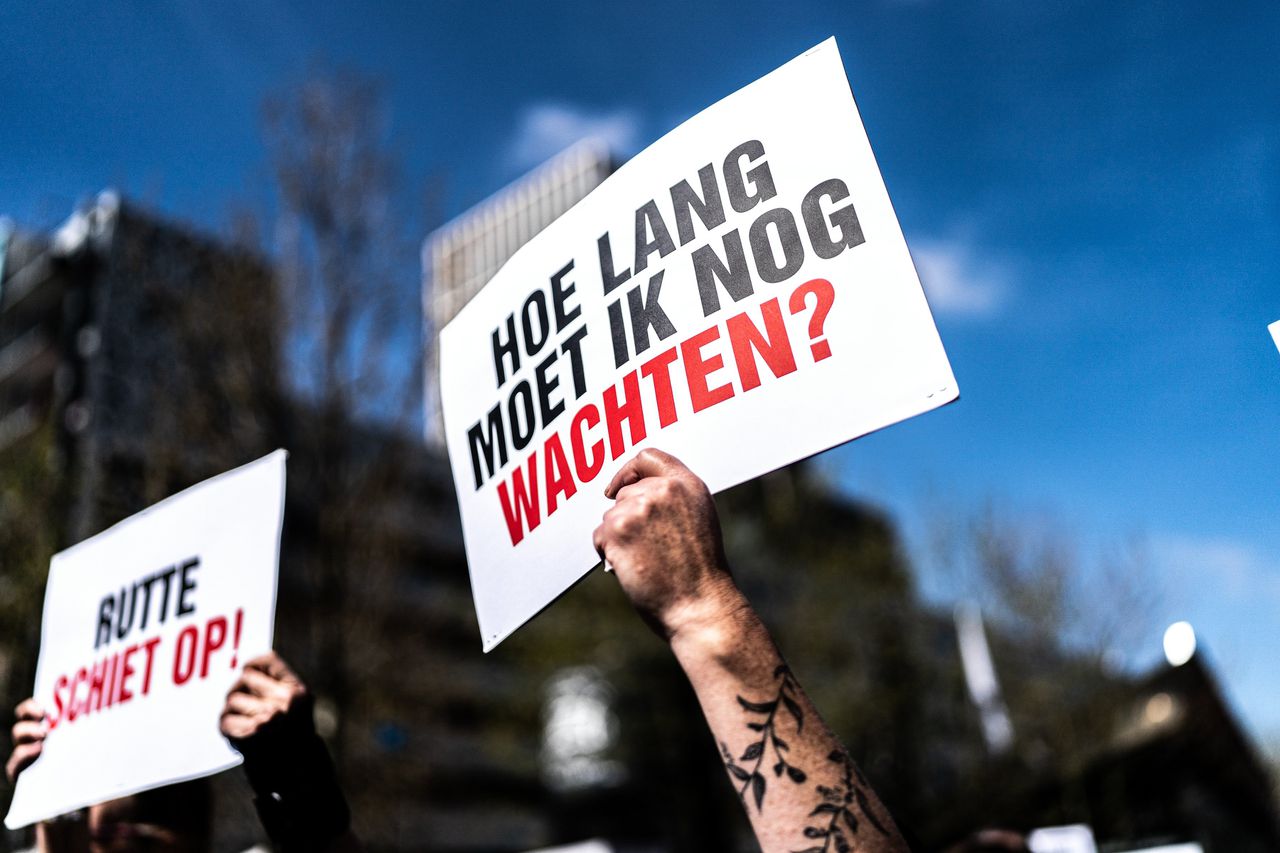
Social and political organizations held a manifestation in Rotterdam in April 2022 to support the parents and children who are victims of the Allowance Affair.
Photo: Joris van Gennip/ANP
Those affected by the Allowance scandal fought against political disinterest for years — until their fate in the media and the House of Representatives finally got attention, the Rutte III cabinet fell over and Pieter Omtzigt, one of their biggest advocates, founded his own party.
Now, the political caravan seems to have moved on. Omtzigt sits home sick, his NSC party is struggling in the polls and the governing coalition is mainly concerned with itself. A technical briefing about the recovery operation for affected parents was held two weeks ago. called off due to a lack of interest among MPs.
All doors that were finally ajar after years of struggle are closing again
Kristel de Waal, victim and member of the parent committee that advises the government
However, the scandal has certainly not been resolved. Thousands of benefit parents — whose tax authorities unfairly stopped and reclaimed benefits between 2005 and 2019 — will still have to wait years for final compensation, because the recovery operation on Fees continues to stall in fundamental parts. The cabinet's goal to help all victims before the end of 2027 does not seem achievable at the current rate. “The outside world thinks it's over,” says Kristel de Waal, herself a victim and a member of the parent committee that advises the government on the recovery operation. “But all the doors that finally opened after years of fighting are closing again. The damage routes are at a standstill, many municipalities have lost interest in helping parents again.” The House of Representatives will debate the recovery operation this Thursday. Secretary of State Nora Achahbar (Allowances, NSC) has already heralded to decide on the further approach after that debate. The fact that the recovery operation goes wrong has four obvious causes.
1 Inadequate information
Who is the last Progress Report If you read about the recovery operation, you will notice that one thing is going well: almost all 69,000 people who have registered as victims have now completed a so-called “first test”. This means that the Implementation Organization for the Recovery of Allowances (UHT, part of the Ministry of Finance) has assessed whether someone's childcare allowance was wrongly stopped or recovered. Whoever that happened will immediately be paid 30,000 euros in compensation through the so-called Catshuis scheme. Most victims then asked for a “comprehensive assessment” because they think they have more than 30,000 euros in damage. At the end of August, UHT had carried out more than 50,000 such assessments, and they are all expected to be completed next year. The comprehensive assessment roughly determines how much childcare allowance was wrongly collected from parents, what allowance they missed out on, adds immaterial (500 euro per claim year) and material damage (25 percent of the wrongful collection), and then comes to an amount of damage.But the problem is: parents do not experience that as a good completion of their recovery. Victims want to know what information UHT bases that amount of damage on, but do not receive the underlying file — or are very slow. This “causes a lot of frustration for victims,” the Working Group on Benefits Lawyers — which assists many thousands of victims — wrote to the Secretary of State last week in a letter sent by NRC has been reviewed. According to the group of lawyers, the documents are “necessary and indispensable for all parties.” Out of suspicion about the lack of information with which the government determines compensation, victims are objecting en masse to UHT decisions and thousands of parents are asking for an additional assessment of their situation via the available routes for “additional compensation”. In the latest Progress Report, the ministry acknowledges that providing files must be faster and more efficient.
The slow settlement costs the Ministry of Finance millions in penalty payments
2The stack of objections
Affected parents have now filed 12,500 objections to UHT's decisions. The department that should deal with these concerns — which was already in crisis a year and a half ago — won't get rid of the stack. Between May and August, approximately 1,500 objections were added and 1,250 were dealt with. By far the most objections (more than 8,500) were filed against the comprehensive assessment. UHT aims to have dealt with all of them by the end of 2026, but according to the latest Progress Report, that aim is “under pressure”. The slow processing is now costing millions. So far, Finance has paid 45 million euros in penalty payments for dealing with objections too slowly, the ministry expects that bill to rise to 157 million euros.UHT did take measures in recent months to reduce the number of objections. For example, the ministry has been offering victims who have objected since September a settlement proposal of 5,000 euros in exchange for withdrawing their objection. According to the Working Group on Allowance Advocates, this is panic football: in last week's letter to the Secretary of State, the lawyers spoke of “a rabbit in the top hat that has caused some unrest again. Victims are not sure what to do with it.”
3 Stuck alternative (1)
For victims, there are two independent routes to have “additional” damage determined after the comprehensive assessment. The older of these two routes, the Actual Injury Commission (CWS), is intended to find out for the most serious victims what damage someone 'really' suffered, for example due to forced relocation, or because people lost their business due to debts. In addition, CWS also tries to quantify the emotional damage that people experienced, for example due to stress about debts, divorce or the removal of children.
On average, parents wait two years for a review by CWS after registration.
But CWS doesn't work for a second, consultancy firm Berenschot concluded last spring in a scathing report, about which Follow the Money was the first to report last week. CWS only gives four to five advice on compensation per week, while 3,000 parents had already reported to the committee at the end of last year. On average, parents wait two years after registration for an assessment by CWS, according to Berenschot “from the parents' perspective and socially unacceptable”. Berenschot describes CWS as an organization without a clear structure or rules of conduct, where it is unclear what the management does with signals about things that go wrong. Among employees, there is “distrust of parents” and even “cynicism about the entire recovery operation”. According to Berenschot, the entire organization of CWS needs to be overhauled. The cabinet initially did not share this report with the House of Representatives — Secretary of State Achahbar of NSC, a party set up with the promise of transparent governance, also did not make it public in the latest progress report. According to her spokesperson, because it is an “internal report”, and the conclusions were included in a improvement plan that CWS drew up in April — and that was made public. According to the lawyers involved, little has come of the “fresh start” that CWS promised in that plan. In recent months, the number of recommendations issued has also remained at an average of 10 per month.
Read also
Recovery surgery Allowances lucrative for employees of the Laurentien Foundation

4 Stuck alternative (2)
Since last summer, the “Laurentien method” has been offering victims an alternative to the queue at CWS. The route via the Foundation (Equal) worthy Recovery (SGH), founded by Princess Laurentien, promises parents a faster and more generous alternative, but barely gets off the ground either, revealed NRC last month. Although the SGH route should have opened in September, victims are still unable to sign up. SGH figures show that it barely processes even earlier applications it received during a pilot project. According to SGH, this is the fault of the Ministry of Finance, which would create “success blocks”. For example, parents should provide all kinds of “receipts” to prove their story. SGH opposes this because the story of victims should be decisive in determining compensation — SGH sees asking for substantiation as government mistrust. But from the contract that the foundation concluded with the Ministry of Finance last July, shows that SGH itself signed agreements to provide any written evidence. Under that contract, parents do not have to provide supporting documents for, for example, broken relationships or friendships, bankruptcy, lost inheritances or physical complaints. Under the agreement, SGH must ask parents for a document in the event of eight major claims, such as forced home sales or the removal of children. According to the ministry, parents only have to make it plausible that a certain event has occurred; proving a direct relationship with the withdrawal of benefits is not necessary. Finances believes that these are documents that parents can easily do aanleveren.Dat SGH took on a major government order while promising parents to operate completely independently of the state appears to be a recipe for continued friction. Meanwhile, the SGH route did not get off the ground last month either: the foundation had wanted to result in more than two hundred claims from victims, there were three. It is still unclear when new victims can sign up. Victims are sad to see the ongoing problems with recovery surgery. Kristel de Waal: “Nothing works, once again the glimmer of hope that parents received is gone. We are close to despair.”
Read also
Fights with Finance, yet Laurentien got a million-dollar job

A version of this article also appeared in the newspaper of November 6, 2024.
.avif)