Mpanzu Bamenga saw that only white people were allowed to walk through — and that he could make a difference for those left behind

Mpanzu Bamenga saw that only white people were allowed to walk through — and that he could make a difference for those left behind

Mar 19, 2024
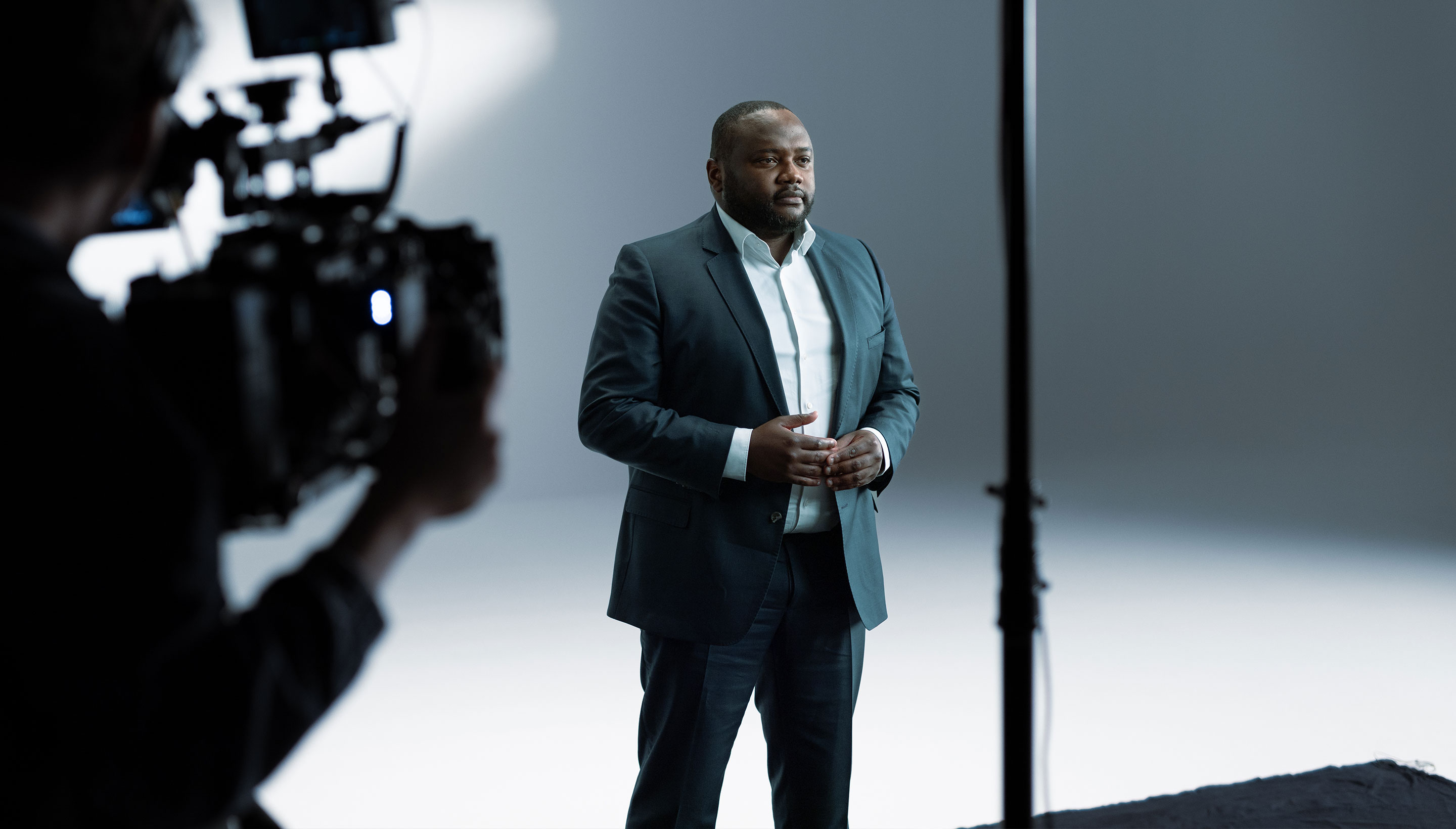
At the age of eleven, human rights activist and D66 MP Mpanzu Bamenga (38) dreamed of a world where all people are treated equally. Since then, he has dedicated his career to fighting for human rights and is a role model in moral ambition.
On April 30, 2018, Mpanzu Bamenga's plane landed at Eindhoven Airport. Mpanzu just came back from a conference in Italy, where he had talked about freedom and human rights. Full of inspiration, he set foot in the Netherlands again. But upon arrival, he was stopped by the military police. “I asked why and was told that they were looking for criminals and non-Dutch people,” says Mpanzu. “Then I saw that another black man was also stopped, and a black woman with two children just like that. I also saw that all white people were allowed to walk through.” For Mpanzu, that day was an important turning point. He was furious, but at the same time he knew he could use his anger as energy. Moreover, he realized that with his legal background, he could make a difference in the fight against ethnic profiling: “I wanted to stand up for those people who couldn't stand up for themselves.” In the following five years, Mpanzu fought with a coalition of human rights organizations to end ethnic profiling. They did this first by filing a complaint with the military police, and later by filing a lawsuit. In the end, Mpanzu's coalition even appealed, after which on February 14, 2023 the historic ruling followed: ethnicity was no longer allowed to play a role in border controls from now on.
“If you have to report to the police every week, when other people don't have to, you're going to think: why is that really?”
Unnatural policy
Mpanzu Bamenga's life story is oozing with moral ambition, with a desire to drastically improve the world. In 1994, when he was eight years old, he came to the Netherlands with his mother. They had fled from the Democratic Republic of Congo and Mpanzu quickly noticed that he was being treated differently in the Netherlands because of his skin color. “You grow up thinking that white is neutral, and everything else is the exception,” he says. “That's racism.” “An important tipping point for me was when, as an eleven-year-old boy, I read the letter saying that we were rejected and had to leave the country,” says Mpanzu. “I realized that we were living in exclusion and were being treated unfairly.” Where some people in Mpanzu's situation would see a racist customs officer or judge (and not unjustly), Mpanzu mainly sees the effect of the wrong policy. When people treat each other unfairly, Mpanzu realized at the age of eleven, you can often trace that back to the laws and regulations of a country. Laws and rules that you can change. “If you have to report to the police every week when other people don't have to,” says Mpanzu, “you're going to think: why is that really? That's when I found out that this is not a natural phenomenon, but something that comes from policies and laws.”
Mpanzu's puzzle
So, what do you do as an eleven-year-old boy when you see that the rules of the world are penalizing you and everyone who looks like you? Mpanzu: “I thought: Who makes those laws? Who makes that policy? These were lawyers and policy makers, so then I thought for myself: I should also become a lawyer.” From that moment on, Mpanzu describes his choices as laying one big puzzle. “Of course, it starts with setting your goal,” he explains. “And if it's very clear, remember: all my actions must be pieces of the puzzle that will make what I want to achieve possible.” For the young Mpanzu, everything from that moment on was about his puzzle. He signed up as a class representative and participated in all debate tournaments he could participate in. In this way, he learned all kinds of skills that he would later need to achieve his goal. “I think it's always important to look at how to train yourself in the best way possible,” says Mpanzu about his approach. “So that you get the right skills, knowledge and attitude to fulfill your role.”
Anger is energy
In 2011, Mpanzu had just completed another important piece of his puzzle — getting his law degree — when his life changed permanently. Mpanzu organized a diploma party and invited his sister, who was living in America with her husband at the time. But his sister was stopped at the border in the United States and placed in detention. For days, she was detained without her medication and without her repeated requests for help being responded to. Eventually, she had a cardiac arrest and died in her cell. When Mpanzu recalls the moment he heard this terrible news, he says that his first thoughts were only sadness, anger, and feelings of revenge: “I had to think: what do I want to do with that anger? Because that anger was energy; I could move mountains.” Ultimately, it was the last message he received from his sister that helped him redirect his energy. “In her last text to me, she wrote that she believes in my dreams,” says Mpanzu. “And that she thinks I should follow them. The only regret is that she won't experience it herself again. That showed me that I should use that energy to do good, and to prevent people from ever ending up in that situation again.”

“What are you going to do about this?”
So Mpanzu already had all these experiences and knowledge with him when he was asked to step out of line at Eindhoven Airport in 2018. “In a few seconds, it went through me: Mpanzu, what are you going to do about this? What can you do about this?” One thing he knew for sure: he had to look for allies. “I've always seen that you can have the best ideas, but you can never realize them if you don't build coalitions,” he explains. “So you have to be supportive of your goal, and not put yourself at the forefront.” Mpanzu worked with the human rights organizations Amnesty International, Control Alt Delete and PILP to end ethnic profiling by the military police. And that, as far as he is concerned, is just the beginning. Mpanzu strives to end institutional racism and knows that to do so he should not be in court, but where all laws are made in the Netherlands: The Hague. He now sits in the House of Representatives on behalf of D66. Is it strange to also see that day at Eindhoven Airport as an opportunity afterwards? “Strangely enough, that goes through your head in just a few seconds, because timing is everything,” says Mpanzu. “You have to choose which battles to fight and which not to fight. And something inside me said: I can prove this and I'm now in the right position to do something about it. Then I think it's my responsibility to do that too.”
About Mpanzu
- Mpanzu Bamenga
- Born in 1985 in Kinshasa (Zaire)
- Studied Dutch Law and completed the postmaster European Law in the field of Migration & Asylum in Brussels in 2013
- Since 2014, a municipal councilor on behalf of D66 in Eindhoven
- In 2020, filed a lawsuit with a coalition of human rights organizations against the military for ethnic profiling
- Member of the House of Representatives on behalf of D66 since December 6, 2023
Mpanzu's reading tip
📚 About the Spirit of the Laws (De l'Esprit des Lois), Montesquieu
.avif)