Comparable crime, different punishment: what's involved in court

Wednesday, October 9, 6:00 AM
Comparable crime, different punishment: what's involved in court
Sala van der Gaag
Jeanine Duijst, editor of NOS op 3
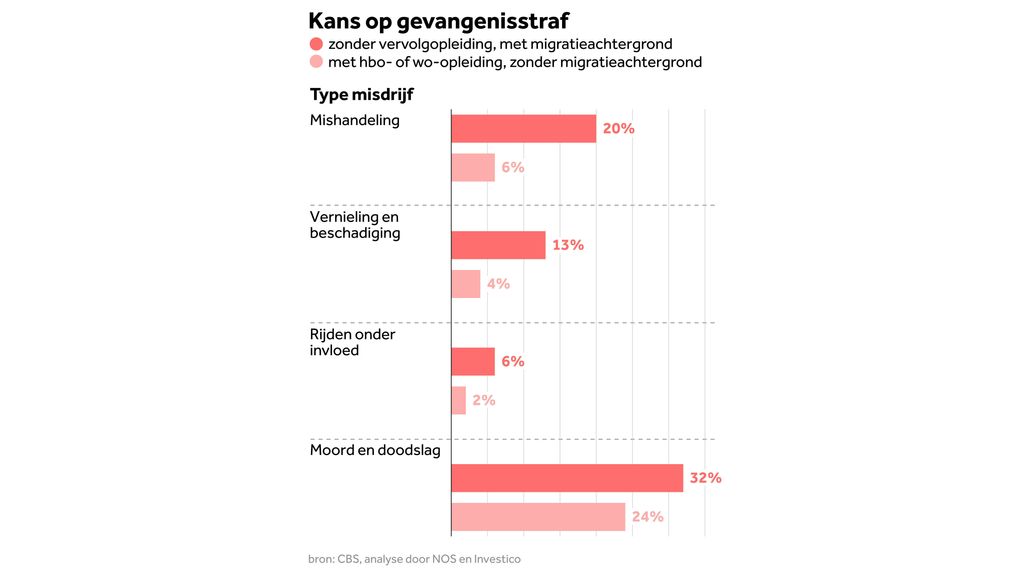
People who commit a similar crime do not always receive the same punishment. Suspects without further education and with a migration background are sentenced to prison almost three times as often as suspects with a higher professional education or university education who do not have a migration background.
For the first group, the risk of imprisonment is 23 percent, for the second group 8.3 percent. This is evident from an analysis of figures from the Central Bureau of Statistics (CBS) carried out by NOS on 3 in collaboration with investigative journalists by Investico.
Prosecutors are more likely to prosecute suspects with a migrant background, the judge declares them guilty earlier and they are more likely to be jailed.
More than one million decisions
This effect is visible in all fifteen crimes investigated. From 'simple' theft (shoplifting or pickpocketing) to abuse and murder and manslaughter. The figures show that the suspect's educational level makes the biggest difference, more than a migration background. The greatest effect can be seen when combining the two characteristics.
This video shows how your background plays a role in court:
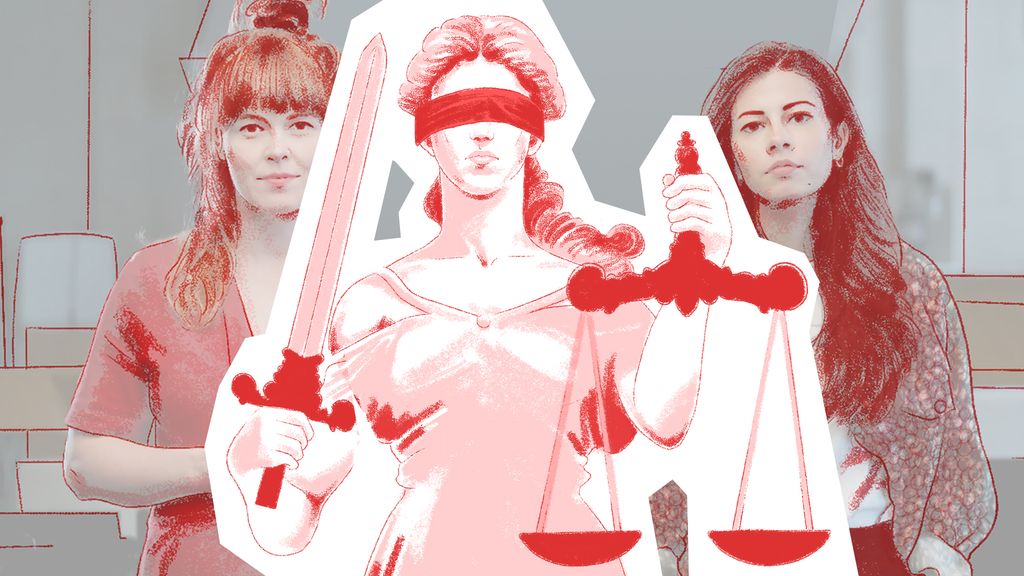
Same crime, different punishment: disparity in court
Together with Investico, NOS op 3 analyzed 1.2 million decisions by the Public Prosecutor's Office, more than half a million court rulings and more than 200,000 prison sentences. This is the first time that these figures have looked at the influence of educational attainment.
Important note: the figures do not tell whether the difference in penalties is, for example, because a suspect has been tried before. In that case, the judge often gives a higher sentence. The figures therefore do not tell why the penalties differ.
The Scientific Research and Data Center (WODC) concluded earlier based on interviews and literature “that it is likely that important aspects of class justice may occur in the criminal law chain in the Netherlands”.
Personal circumstances
In addition to analysing the figures, NOS op 3 and Investico also spoke to dozens of prosecutors, judges and lawyers. The differences in punishment imposed are partly explained by the people in the case law by the freedom that judges have to look at the defendant's personal circumstances.
Many judges included in the study believe that those higher up the social ladder have more to lose. Press judge Jacco Janssen: “These personal circumstances fall into three categories: work, living and any kind of relationship. Then there's the advantage, when we're on the cusp between imprisonment and community service, of trying to let people who have jobs keep that job. If we remove them, we may be further away from home and society will not benefit either.”
Several lawyers are questioning this. For example, lawyer Milan van Hulst says: “People who go to prison who are already struggling are even more behind when they are released. They can no longer get a statement of behavior and they will have to explain what happened during the time they were incarcerated at every conversation, whether it's for housing or a job. So it's going to be even harder than before to make something out of life.”
'No math and statistics'
In a written response, the Council for the Judiciary (the organization that represents judges in the Netherlands) says that no one can completely rule out unconscious (preliminary) judgments, including judges. But that they continuously “reflect” on this pitfall. “It is the judge's job to determine which punishment is appropriate, with the best effect on the perpetrator and society. Discrimination or class justice is at odds with the core values of the case law. Every suspect has the right to a fair trial.”
The council also says that the figures “appear to be broadly in line with the image we know from previous studies on the subject”.
The Public Prosecution Service does not elaborate on the findings, but emphasizes that “punishment is not math and statistics, but roads and practical wisdom”.
The Ministry of Justice and Security says in a response that last June, the WODC launched an investigation into the overrepresentation of people with a migration background in criminal law. This will also investigate the extent to which there is unequal treatment in the criminal justice chain based on the socio-economic position of suspects.
Accountability
For this story, NOS analyzed out of 3, together with Investico, 1.2 million decisions by the Public Prosecutor's Office, more than 500,000 court rulings and more than 200,000 prison sentences. The period 2013 to 2022 was looked at.
Training is hereby divided into three categories:
- no further education (primary education, practical education, special secondary education, VMBO)
- HAVO/VWO, mbo
- hbo/wo
Migration background is also divided into three categories:
- born abroad
- born in the Netherlands, but parent (s) outside the Netherlands
- born in the Netherlands and both parents in the Netherlands
Two groups were made of this: suspects with a migration background and suspects without a migration background.
The comparison was always with two groups:
- the most privileged group: hbo/wo educated, without a migration background
- the least privileged group: no further education, with a migration background
The raw data from the CBS are here to find. More about the analysis and the full adversarial is here available at Investico.

.avif)