Cooperation - Together Everyone Achieves More
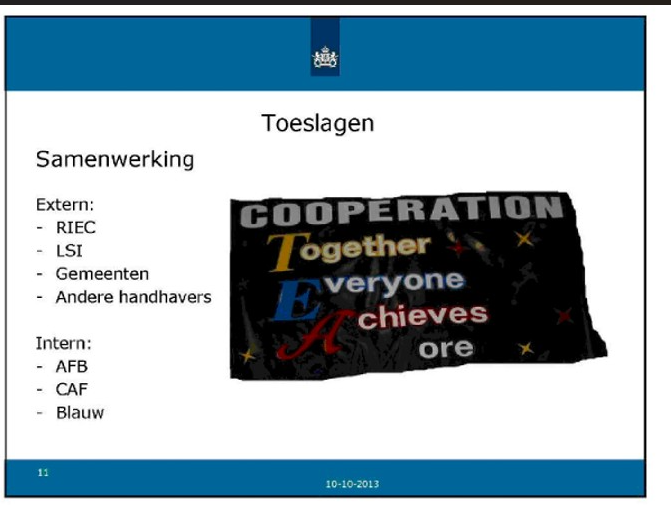
This slide from October 10, 2013, comes from the CAF Team, which came up with the idea to start collaborating. Fraud signals in the PIT lists (person-oriented intensive supervision) ended up in the FSV lists. This data was to be shared. Internally: with the Anti-Fraud Box, the CAF Team, and the Blue department (SMEs). Externally: with the RIEC (teams combating subversion and crime), LSI (focused on social security/benefits domain), municipalities, and other enforcement agencies.
Tips & Tricks
BDO sent the investigation report on the Datavault, which had disappeared under the radar, to the House of Representatives on July 20, 2026. It covered topics such as CAF, FSV, and RAM. Documents that should have been included were not provided, despite requests. The collaborative workspaces are also missing.
I recently received, via the Central Netherlands District Court a letter from the Ministry of Finance. I have been searching for a long time for the 'recipe book' used to put entrepreneurs 'out of business.' I read about this recipe book in the CAF weekly newsletters. It evolved into a 'Wiki Guide for Special Tax Authority Clients.' According to the Ministry of Finance, the recipe book does not exist. It is a collaborative workspace.
From the weekly newsletters, I can deduce that all sorts of information can be found there if you want to eliminate an entrepreneur as quickly as possible. Collaboration is key in this regard. For example, a municipality can revoke a registration. Tips and tricks for a quick knockout.
How do we handle completed Woo requests and parliamentary requests? How do we handle new Woo requests? The Anti-Fraud Box folder contains 318 files. Among these are the PIT and FSV applications. There are also files related to the development of risk models. The 'Strategic Team' folder for SMEs contains documents that were supposed to have been provided. How do we handle personal data that should have been destroyed? These questions are addressed in the BDO report.
Extortion and discrimination
On January 14, 2020, a question hour took place in the House of Representatives. Who is responsible and guilty regarding the 'benefits scandal'? Were there criminal offenses, and should a report have been filed? The law firm Allen & Overy investigated this. A memorandum followed. Suspicions of criminal offenses were identified (they had received the CAF weekly newsletters), including extortion and professional discrimination. On May 19, 2020, a report was filed against the Tax Authority on behalf of the State Secretary based on these findings. The National Criminal Investigation Department is conducting the criminal investigation. Mailboxes and digital environments were immediately secured. Mailboxes of 1,020 Benefits employees, 2.6 TB from the N-drives, and the Connect People collaborative workspaces. It turns out they were not read and were not included.
Crucial information about entrepreneurs who saw their businesses fall into dire straits due to unfounded fraud suspicions is contained in the Datavault.
Entrepreneurs suspected of systematic fraud.
Read the parliamentary letter about the Datavault here:
Parliamentary letter with update on Datavault | Government.nl
NOS reports:
Tax authorities discover data vault containing files potentially relevant to the benefits scandal
.avif)
Latest articles & insights
I will continue to actively share my research through articles, analyses and updates about new developments.
PRESS RELEASE: “EVERYTHING LOST AND NOTHING RESTORED” - EMBARGO UNTIL MAY 7, 5 P.M.
EVERYTHING LOST AND NOTHING RESTORED - GENEROUS RECOVERY AWAYENTREPRENEURS WERE UNFAIRLY TRIPLE HIT AND DUPED BY THE ACTIONS OF THE TAX AUTHORITIES On May 7, 2026, at the initiative of the House of Representatives, Inge van Dijk (CDA), an interview took place at the Ministry of Finance, Korte Voorhout 7 in The Hague. The state secretaries of the Ministry of Finance Sandra Palmen (Allowances) and Eelco Eerenberg (Tax Administration) with Paula Bouwer, Stichting Herstel Onbekend Inrecht (which lost three companies) and representatives of the Interest Group for Duped Entrepreneurs Allowances/FSV/SMEs. Present are Alex de Wilde (who experienced bankruptcy in his employment agency), Gulsah Akpinar (who experienced bankruptcy with her childcare institution) and Joost Allein Richir (who worked as a lawyer at the tax authorities for more than 40 years and is now working for the foundation as a volunteer). According to the EU, entrepreneurs have “the right to the freedom to do business”. They have been deprived of this right.
Allen & Overy partner Hendrik Jan Biemond resigns
Hendrik Jan Biemond Photo: Peter Boer/De Beeldunie Hendrik Jan Biemond, one of the best-known corporate criminal law specialists in the Netherlands and a partner at Allen & Overy until recently, has quietly quit as a lawyer. 'I found it after...
A benefits fraud affair and claims of institutional racisme are among issues that led to crisis of trust
The Observer Netherlands Dutch parties vie for voters with no faith in government after string of scandals A benefits fraud affair and claims of institutional racism are among issues that led to crisis of trust before this week’s general...