Lacquered but not broken: portraits of mothers after the benefits affair

Plus Portraits
Lacquered but not broken: portraits of mothers after the benefits affair
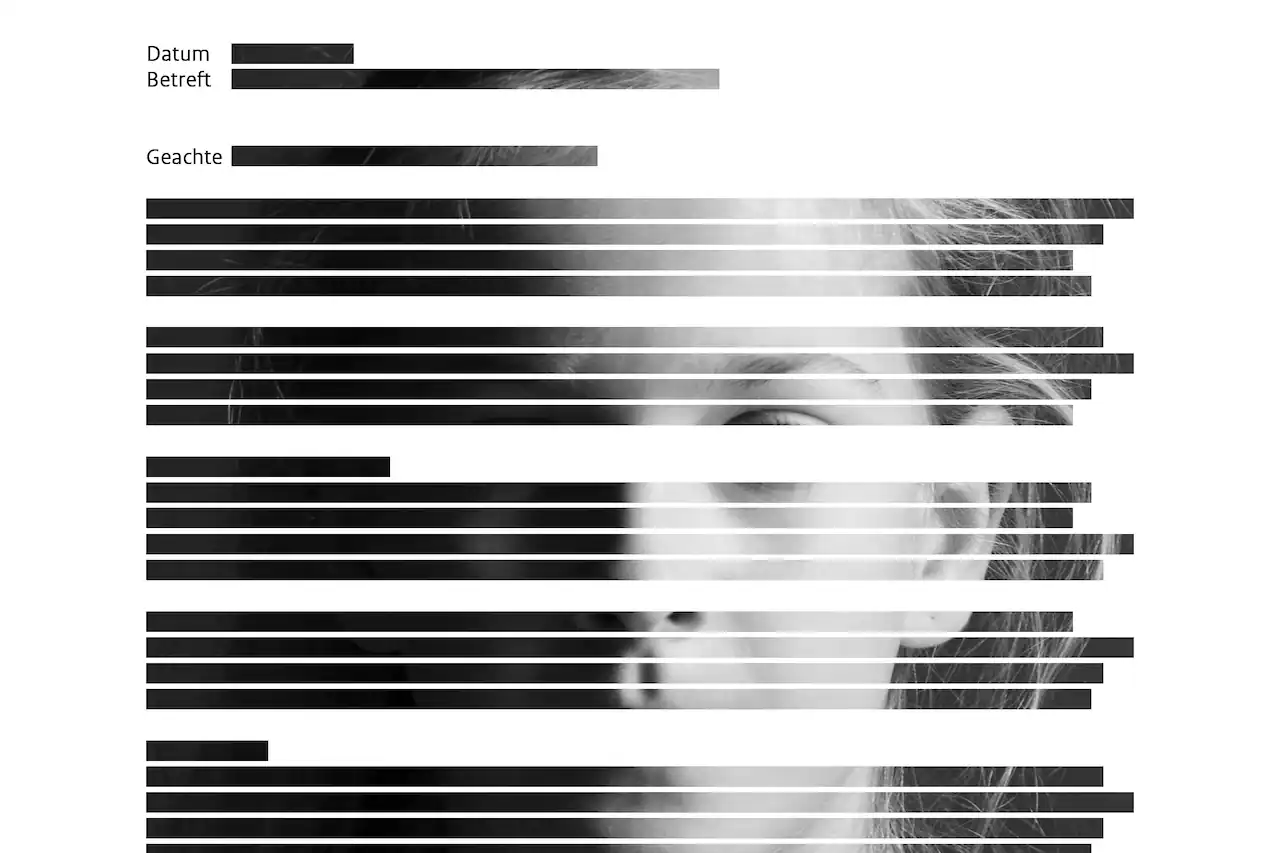
The childcare allowance affair has led to major money problems, disruption and stress in many families. Seventy percent of the victims were single mothers. Esther Velrath photographed seven women and one girl for her portrait series Blocked .
Marloes de Moor May 18, 2024, 3:00 AM
The outrage on social media and in the House of Representatives is great when, in December 2019, it appears that the tax authorities have painted entire pages of black paint in the personal files sent to victims of the benefits affair. Earlier that month, affected parents protested in front of the office of the tax authorities in Rotterdam to demand access to their file. They want to know why they are seen as fraudsters and what was the reason for stopping and recovering the childcare allowance. But when some parents eventually receive their file, page after page appears to have been made largely unreadable. According to the then Secretary of State Menno Snel, this has to do with the legal duty of confidentiality and the removed parts contain personal data, prohibited information about third parties and the names of employees of the Service Supplements.
The news report also shocks Esther Velrath (49), who was currently a student at the Amsterdam Photo Academy. For years, she has been closely watching the news about the childcare allowance. “When I became a mother in 2014 and my child was enrolled at a daycare center, I was told to be very careful when filling out the forms. If it went wrong, the misery was incalculable. Rumors of a scandal at that time were already around. They turned out to be true: four years later, the benefits affair came to light.”
Smashed again
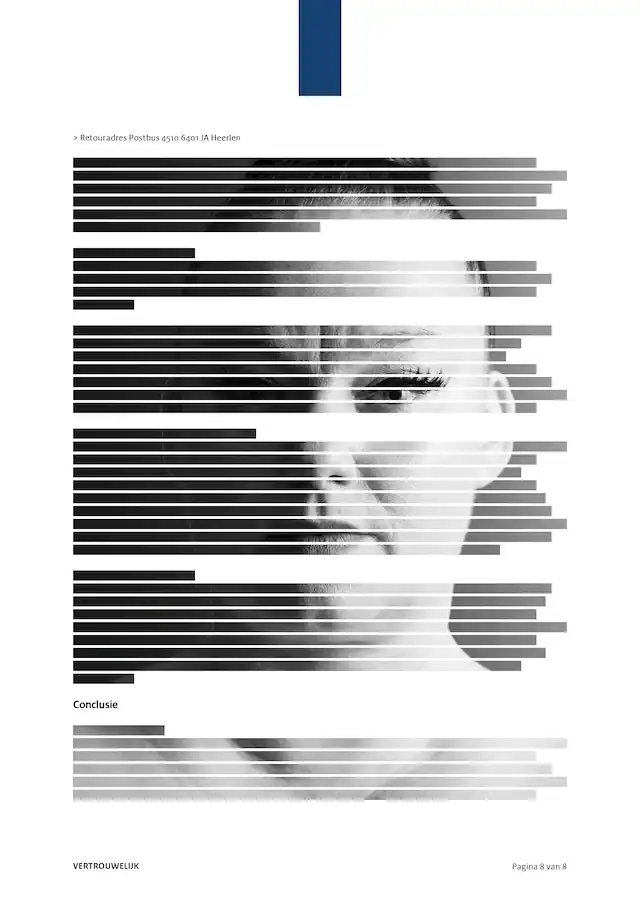
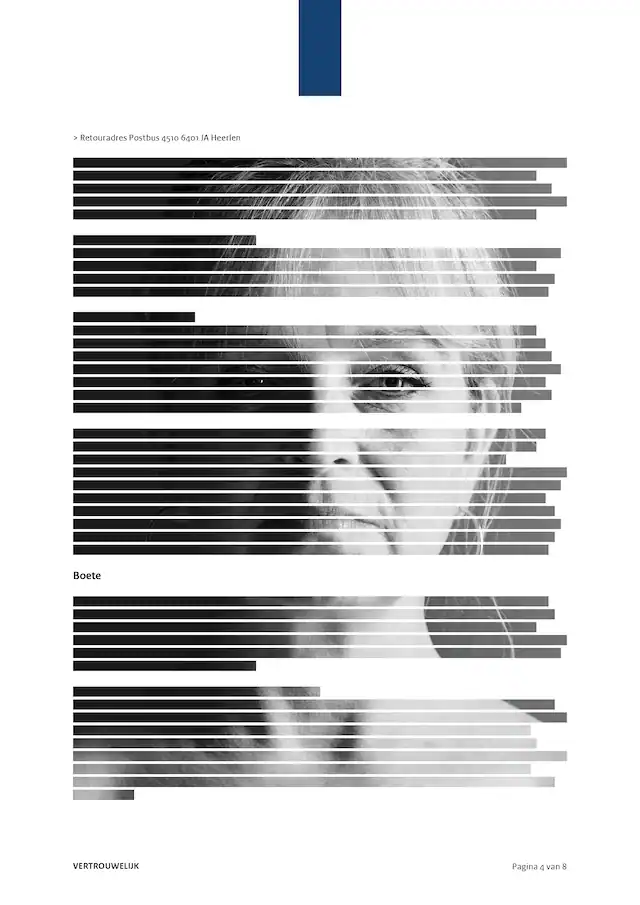
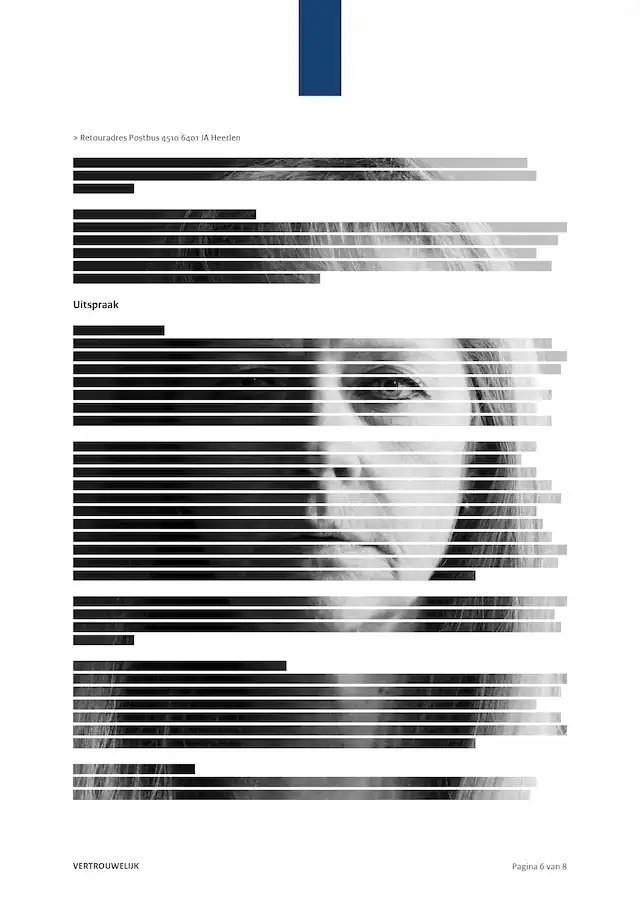
The black-painted pages make Velrath think and lay the basis for her exam project. “I immediately saw a clear picture in front of me: vulnerable-looking people who blend into the black-painted pages of the tax authorities, who are literally and figuratively stuck in the system. I wanted to shoot them with split lighting, where one half of the face is illuminated and the other is shaded. It was so strong in my head that I had to do something with it,” says Velrath.
In addition, she wants to convey a message with her project. “I think the attention to the subject is still very poor, even if it is fading. After a second parliamentary investigation, errors seem to have been corrected, but it continues. For many people, the case has still not been settled. They are still fighting for fair compensation. Moreover, this can happen again at any time. In addition, the report Blind to people and justice of the Committee of Inquiry into Fraud Prevention and Services along too. If these patterns persist, people can be crushed again.”
Through Stichting Herstel Onbekend Inrecht, which defends the interests of those affected by the childcare allowance affair, Velrath comes into contact with seven women and one of them's daughter. She would like to participate in her photo project under the title Blocked . “I photographed them in the Photo Academy studio. At her mother's request, I only captured the girl fairly unrecognisable. In the photos, I saw strong women who fight for their rights and children, but at the same time they seem to be struggling. Every day, she still pays off the physical and mental consequences of this scandal.”
Recovery scandal
Esther de Reu (46) is one of them. Since 2008, they have incurred more than 100,000 euros in debt as a result of the benefits affair. “I was just surviving with my two sons. You don't have a moment of rust, you're constantly looking for money, you're busy solving debts. I always had to submit data to the tax authorities, but never yielded anything. I found myself in front of closed doors. This has had major consequences. We were no longer able to pay the rent and left our house in Enschede. Now we are forced to live with my mother in Amsterdam, but that is actually unsustainable. My youngest son, now sixteen, suffered trauma and was no longer afraid to go to school. He was bullied enormously because we had little money.”
The situation causes chronic stress and physical symptoms such as high blood pressure and a high heart rate. “Mentally, you can still fight, but physically it stops at a certain point. It literally makes you sick. I could have lost my mind, but my faith in God has kept me down. That is not the case with everyone. There are also victims and even children who are largely ending their lives.”
De Reu has now received 30,000 euros through the Catshuis scheme, which ensures that victims receive compensation more quickly. Those entitled to more should wait for further processing. “That takes a long time,” she sighs. “Among victims, we already call it the recovery scandal, because little happens.”
By participating in the portrait series, De Reu wants to show what the benefits affair does to you. “Not only for me, but also for the other victims, I think it's important to keep telling the stories and creating awareness. This can happen again. In fact, it's still happening.”
Kristie Rongen (49) from Lelystad, who was also portrayed, agrees. “With this photo series, we show that we will keep fighting and make people aware that everyone can overcome this.”
Velrath photographed the women close and without outerwear to show their vulnerability. Rongen fully agrees with that: “I feel that way too. I still want the powerful government. But it gives me a good feeling that there are also people who support me, like Esther. Then I feel heard.”
Antidepressants
Rongen gained national fame when she made Prime Minister Mark Rutte face to face during an election debate in 2021. For years, they were labeled a fraud and they had to repay ten 92,000 euros to the tax authorities. “I combined evidence after evidence, but none of it would be well-founded. Whatever I provided was never the right thing. What I did wrong, I thought I was doing something wrong. When the scandal came out, I thought, you see, I'm not crazy! But in between, my life and that of my three children were turned upside down. I couldn't afford rent, gas and electricity and had hardly any money for food. Up the smooth walk. My son was even unable to go to secondary school in Almere because I had no money for his train ticket. It has had a lot of influence on my children's future.”
Rongen has now received back the money she had already paid to the tax authorities, but that's not the end of it for her. She is still working with the Actual Damage Commission, which will take action if the compensation from the Implementing Organization for Recovery Allowances (UHT) is not compensation. The actual damage may be higher if, for example, someone is unable to work or has had serious problems due to the benefits affair. “That pays off for me. And my children still deserve the consequences of it every day. As long as that is not sealed, I have no rust. The worst part, I think, is that all this misery wasn't necessary. The frustrating thought keeps me busy day in, day out. I went through a deep valley and took antidepressants. At mental health care, I followed group therapy in connection with mental problems. What still helps me the most is painting and making sculptures out of cement. Then I can even get out of my head and stop worrying.”
The stories touch Velrath. “This has done so much to them. When I put my daughter to bed at night and smile when she falls asleep, I think: some people miss this happiness. They lost it, but it can also overcome me. The women I've captured are hardworking single mothers who were well off until they got stuck in the system.”
Velrath also wants to highlight the lack of self-determination and the majority of the human dimension in her work in other ways. “That goes beyond just the benefits scandal. The increasing digitization, algorithms and the development of AI are frightening. We are becoming increasingly dependent on this and are threatening to lose sight of the human dimension. The danger is that people are increasingly and longer caught up in the world of laws and regulations. I want to put this topic on the map with my work. I hope we learn from our mistakes and fix them in time so that this does not happen again and that entire groups of people and new generations are not sidetracked.”
Childcare allowance affair
Thousands of parents who receive childcare allowance were unfairly indirectly as fraudsters by the tax authorities from 2004 to 2019. They often have to receive the surcharges — tens of thousands of euros — in one lump sum. As a result, they ended up deep in debt; people are disrupting their homes and even becoming children removed from home . As early as 2014, parents sought legal help.
In the autumn of 2018, the benefits affair was publicized. Former MPs Renske Leijten (SP) and Pieter Omtzigt (then CDA) can take huge advantage of the file.
In 2020 the report appeared Unprecedented Injustice from the Parliamentary Childcare Allowance Interrogation Committee, which concluded that many parents had committed an “unprecedented injustice” in the childcare allowance affair. Basic principles of the rule of law were violated when implementing childcare benefits, the investigation shows. In 2021, the cabinet resigned because of the affair.
In February this year, a second report by the Parliamentary Committee of Inquiry into Fraud Policy and Services was published, Blind to people and justice . The main conclusion is that the benefits affair was caused by the violation of fundamental rights and the overriding of the rule of law. This week, it turned out that the settlement of the affair was 5 billion euros more expensive than calculated. The total cost of the recovery operation thus amounts to 14 billion euros.
The book was published on May 7 We can't make it more fun by Renske Leijten. She describes the personal, human side of the benefits scandal.
.avif)