Dutch parties compete for voters

Dutch parties compete for voters without confidence in the government after a series of scandals
This article is over 1 month old
An affair involving benefits fraud and claims of institutional racism are among the issues that led to a crisis of confidence before this week's general election.

Sandra Palmen, the tax office lawyer who sounded the alarm about a scandal in which 31,000 Dutch families were falsely accused of benefit fraud. Photograph: Judith Jockel/The Observer
Sandra Palmen was the whistleblower in a scandal where 31,000 Dutch families were falsely accused of fraud — often with dual nationality, single mothers, or working families in less prosperous postcodes that were financially and personally ruined by wrongly paying back every cent of years of childcare allowance.
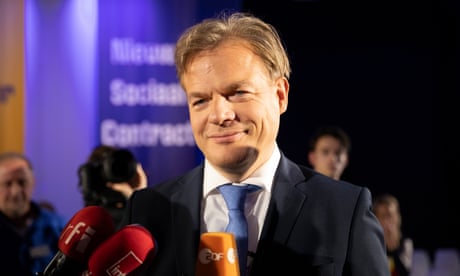
But Palmen, a prominent corporate lawyer who wrote an official memo in 2017 saying an anti-fraud campaign had gone completely wrong, was the only tax office employee expelled. Now she faces a new political party led by a campaigning backer, Pieter Omtzigt, who calls for a social contract to repair a series of government scandals in the Netherlands.
“There was a kind of market thinking in the government, like it was a cookie factory that brought new flavors to market,” says Palmen. “Now, people want a different kind of government, protection of their rights, and be heard and seen.”
With government trust in this small democracy of 17.9 million people persistently low, there has been an explosion of new political parties vying for middle position under the Dutch system of proportional representation as the general elections approach on Wednesday.
The New Social Contract (NSC) — founded in August by former Christian Democratic MP Omtzigt — is one that is center-right; on the left, EU heavyweight Frans Timmermans is leading a new merger of the Labour and Groenlinks parties.
The provincial elections in March, in which the senate decides, were won by another new vote: the agrarian populist Farmers-Citizen Movement (BBB). Even in the most successful established party, Mark Rutte's People's Party for Freedom and Democracy (VVD), there is a new leader of Turkish Kurdish origin, Dilan Yeilgoz-Zegerius , who claims to be a fresh voice.
One of the reasons why a once stable system has broken — the latest poll by the broadcaster RTL shows that 59% of voters have still not made up their mind — is an unprecedented period of government scandals, one after another.
The childcare allowance affair was the first to come to light in 2020, which made Palmen's name known.
About ten years ago, the government cracked down on fraud in the benefits system, despite advice from officials that 90 to 96 percent of applications were not fraudulent. People were wrongly punished as fraudsters for minor errors, and the legal checks and balances didn't work.
When Palmen was a specialist advisor at the benefits agency, a director asked her to look at the files of several hundred families represented by a lawyer.
“In the middle of a year, benefits were stopped and people didn't know why. Their objections were not listened to,” she said. “It was all or nothing. All their fundamental rights were violated. In the management team, there were people who had the feeling that things were not right, but couldn't put their finger on it. But I could do it, so I wrote that memo. '
This 2017 memo, in which she said the policy was wrong and that the victims should be compensated, came to Omtzigt's attention: it helped lead to a parliamentary investigation that ruled that families had experienced an “unprecedented injustice”, a multimillion-euro compensation scheme, the fall of a previous government and the creation of the NSC, which is now fighting to become first in the polls.
Palmen is not the only one prompted to act by the series of Dutch scandals, including ignoring decades of local earthquake damage in the province of Groningen; “institutional racism” becomes admitted by the Minister of Finance at the tax office; ethnic profiling by the border police; and a political scandal about placing Omtzigt in a” position elsewhere ”, where he could cause fewer problems.
A generation of politicians is resigning and new governance is a central theme of Timmermans and the Farmer Citizen Movement. “It's not a crisis of confidence,” says Tom van der Meer, professor of political science at the University of Amsterdam. “It's a crisis of confidence.”
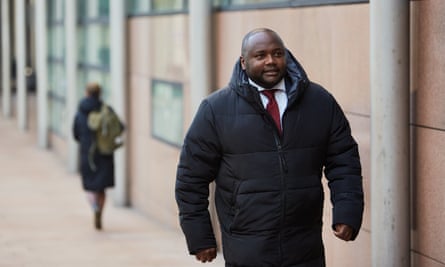
Mpanzu Bamenga, representative of the liberal democratic party D66, won a lawsuit against border police in February to stop ethnic profiling. He says people have lost faith in a government that has violated its own constitution on issues such as discrimination. “When you lose that [faith], you also lose what makes us a society: solidarity,” he said. “Now it's up to the government to understand that they're there to serve our society.”
Some believe things could change under what could well be a minority coalition. 46-year-old Wendy Lisse, from the Amsterdam-Zuidoost district, noticed that she was being extra checked for benefits because of her zip code, and said that the scandals would cause many victims to vote for change. “I do have hope,” she said.
The political explosion ended complacency in a country where systematic prejudice and nepotism may have been underestimated.
“The Dutch have woken up,” says Bert Bakker, political communication expert at the University of Amsterdam. “We've always been a very well-organized and fair country, but there's more focus on the fact that some of the things we've always thought were just and right may not have always happened that way.”
Kristie Rongen, one of the parents who was wrongly told to pay back €92,000 (£80,000) to the benefits office — including €20,000 in interest — stands for the Socialist Party. The 48-year-old from Lelystad hopes that the VVD, which led four governments, will be punished by the voters. “It was numb and my heart goes out to the kids,” she said.
But Willem Gispen, 71, who lives in Groningen and whose home was damaged by the many earthquakes in the area, is less hopeful. He says that the VVD is ahead in some polls under its new leader, who is waging a charm offensive to learn from previous mistakes.
“An earthquake is a bad experience, but the worst thing is what happened next: the uncertainty, the lack of clarity, years of not being taken seriously,” he said. “The aftershock is even worse.”
Meanwhile, voter dissatisfaction may also play into the hands of the extreme right-wing politician Geert Wilders, whose PVV opposes Islam and wants an immigration “stop”. An opinion poll on Saturday showed that he suddenly received votes to join the VVD as the largest party, leading to a call on the left for people to vote tactically to keep him out.
Like the difficult coalition talks ahead, a major cultural change in the Netherlands will not happen overnight. “The Dutch are people who want to participate, want to sit at the table, but at some point many of them have run away,” says Palmen.
“I hope that people can trust us and that we can make it happen.”
This article was amended on November 20, 2023 because an earlier version referred to the city of Groningen when referring to the province of the same name.
.avif)